
Waalaxy Alternatives Worth Switching To And When To Stay Put
Waalaxy costs 19 to 69 EUR per seat, but the cap, seat and reply problems lead to different tools. Compare Expandi, HeyReach and more before you switch.
Why are you looking for a Waalaxy alternative?
Usually one of three things. The 300 invitation cap on the cheapest plan, the per-seat price when you add two colleagues, or the fact that the tool sends and then stops, leaving you with an inbox of replies at 9pm. Which one it is decides your shortlist, and the three lead to different tools.
The seat problem is the one people misprice. Three colleagues on Business is 207 EUR a month and 2,484 EUR a year, and the 800 invitations are per seat. Two of those seats are new accounts, and a new account can only send 5 to 10 invites a day for its first two or three weeks. You are paying 138 EUR a month for capacity that cannot legally be used yet.

How much does Waalaxy cost, and when does it stop being cheap?
Waalaxy runs 19 EUR per user a month on Pro with 300 invitations, 49 EUR on Advanced with 800, and 69 EUR on Business with 800 invitations plus email sequences, tier by tier. One seat on Advanced is cheap outbound software. The invoice is not where the money goes.
Work the 800 through. A warm account can safely send 20 to 25 invites a day, so 22 working days gets you 550. You are paying for 800 and can responsibly use about two thirds of it on one account. At a 20 to 30% accept rate, 550 invites is 110 to 165 connections. At a 12 to 18% first-message reply rate, that is 13 to 30 conversations you personally have to run every month.
If you are one person sending under 300 invites a month, stay on Waalaxy Pro at 19 EUR. Nothing on this page saves you enough to justify rebuilding your sequences.
What are the best Waalaxy alternatives right now?
The names worth shortlisting are Expandi, HeyReach, La Growth Machine, Dux-Soup, PhantomBuster, Salesforge and Lemlist, plus Kaspr and Cognism if what you actually want is contact data rather than sending. They split into three groups: cheaper senders, multichannel senders, and tools that do the outreach work instead of you.
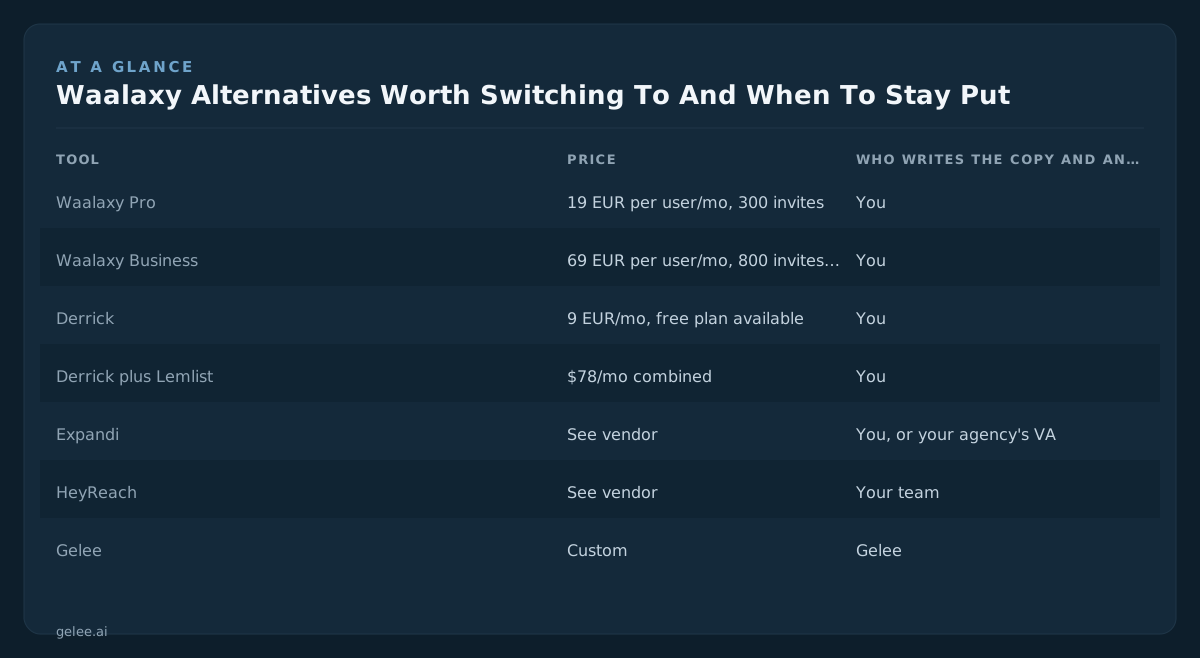
| Tool | Price | Who writes the copy and answers the replies |
|---|---|---|
| Waalaxy Pro | 19 EUR per user/mo, 300 invites | You |
| Waalaxy Business | 69 EUR per user/mo, 800 invites plus email | You |
| Derrick | 9 EUR/mo, free plan available | You |
| Derrick plus Lemlist | $78/mo combined | You |
| Expandi | See vendor | You, or your agency's VA |
| HeyReach | See vendor | Your team |
| Gelee | Custom | Gelee |
Pick by group, not by feature list. Dux-Soup suits one person running one account on a budget. Expandi is the agency choice when you are running eight or ten sender accounts. La Growth Machine is for teams who already have verified emails. Kaspr and Cognism are not replacements at all, because they sell you contact data and leave the sending somewhere else.
Which Waalaxy alternative is actually cheapest?
Derrick, at 9 EUR a month with a free plan. One comparison stacks Derrick plus Lemlist at $69 for cold email against a Waalaxy Business setup, $78 a month against $160. Dux-Soup is the other budget pick, aimed at one person running one account rather than a team.
Cheapest on the invoice. Twenty-five invites a day plus answering the replies is roughly an hour a day, so 20 hours a month. At $50 an hour that is $1,000 of your time sitting on top of a 9 EUR subscription. At $100 an hour it is $2,000. The 9 EUR tool is then the most expensive line in your stack by a factor of 200.
Which alternative is safest if you want to run real volume?
Expandi is the one agencies pick for scaling multiple accounts, and HeyReach adds real-time campaign monitoring and a wider set of LinkedIn actions than Waalaxy's template-led approach, by HeyReach's own comparison. Neither removes the ceiling. LinkedIn does not publish a daily invite limit, and it moves with account age and how people respond to you.
Our own safe numbers: 20 to 25 invites a day on a warm account, 5 to 10 a day on a new one for the first two or three weeks. A tool that lets you queue 100 a day still sends through the same LinkedIn account, and the restriction notice tends to arrive around week three.
If you genuinely need 100 invites a day, that is four warm accounts at 25 each, which means four profiles with real headlines, real posts and four humans willing to be seen sending. A faster sender does not get you there.

Do you need email as well as LinkedIn?
If you have verified emails for more than half your list, yes. Salesforge, La Growth Machine, PhantomBuster and Expandi all run outreach across more than one channel. La Growth Machine in particular sells itself on email plus LinkedIn in one centralised sequence.
If you do not have the emails, a multichannel tool is a second subscription you will use at half capacity. A founder with 400 scraped prospects and no enrichment budget gets more from one LinkedIn channel run properly than from two channels run at 50%. Enrichment on 400 contacts is its own line item before the sequence tool charges you anything.
What do none of these tools do for you?
Reply. Every tool on the list sends the invite and the follow-up, then hands you a conversation. That is the part that takes the hours, and it is the part where deals are won or dropped. A Reddit thread comparing Apollo, Lemlist, Dux-Soup, Kennected and WeConnect puts several of them under 2%, which is what template sends without follow-through look like.
Here is the month in full. 550 invites, 110 to 165 accepts, 13 to 30 first-message replies, then 5 to 8% of your follow-ups reply too. You are writing personal answers to roughly 30 people, half of whom ask about price or say "send me info". Across a month that is 15 to 25 hours. No sender tool on this page touches any of it.
Is the tool the problem, or is it your profile and your copy?
Often the profile. If your accept rate is under 15%, switching from Waalaxy to Expandi changes nothing, because the person deciding whether to accept is looking at your headline and your last three posts, not at the software that sent the invite. Fix the accept rate first and the same 550 invites do more work.
Organic reach on LinkedIn fell roughly 50% and what still works has changed with it, which matters because a prospect checks your feed before replying. Run your headline through the LinkedIn headline rewriter before you migrate a single campaign. Moving from a 15% accept rate to 25% on 550 invites is 55 more connections, which at a 12 to 18% reply rate is 7 to 10 more conversations a month from the same sending.
Should you switch from Waalaxy to Gelee?
Only if the thing you want to stop doing is the sending and the replying, not just the sending. Gelee is an AI SDR. It writes in your voice, answers replies, handles objections with your own answers and books the meeting. Setup takes 15 minutes, there is no self-serve signup, and pricing is shared on a demo call.
Do not switch if you want to put a card in tonight and start sending. Waalaxy at 19 EUR takes minutes and Gelee has no signup page. Do not switch if you already employ two SDRs who write good copy, because then you want Expandi or HeyReach to make them faster, not software that replaces the work they are paid to do.
Switch if you are one founder with three LinkedIn accounts, booking six meetings a month, and the reason it is six rather than fifteen is that replies sit unanswered for two days. Our benchmark is 3 to 5% of invites turning into meetings, so 550 invites should produce 16 to 27. The Post Commenters preset covers the other half: it DMs everyone who comments on a watched post, then replies publicly once the DM has gone out, which is the workflow people try to build with ManyChat-style tools that were never made for LinkedIn.