Dripify Alternatives Worth Switching To In 2026
Seat limits, LinkedIn-only sequences, unanswered replies and account restrictions push people off Dripify. Compare HeyReach, Expandi, Snov.io and AI SDRs.
Why do people leave Dripify?
Four things push people out: one seat stops covering it the moment a second sender account joins, LinkedIn-only sequences leave email unused, replies arrive faster than a founder can answer them, and a restricted account sends everyone shopping. Dripify sends the invites. You still write the copy and answer every reply that comes back.
Here is the shape of it for one person. You send 25 invites a day, 22 working days, so 550 invites a month. At a 20 to 30% accept rate that is 110 to 165 new connections. Roughly 12 to 18% reply to your first message. So somewhere between 15 and 30 humans are now waiting on an answer from you, in an inbox, while you are on a customer call. No automation tool on this list answers them for you.
The restriction case is the ugliest one. An account that picks up a warning goes back to 5 to 10 invites a day for a couple of weeks before it is safe at 20 to 25 again. Two weeks at 7 a day is about 100 invites instead of 250, which at a 3 to 5% meeting rate costs you four or five meetings. Switching tools mid-restriction does not give them back. The pricing complaint is a separate one: HeyReach's own review of Dripify makes seat count the headline difference, charging one flat fee for unlimited sender accounts instead.

What are the best Dripify alternatives in 2026?
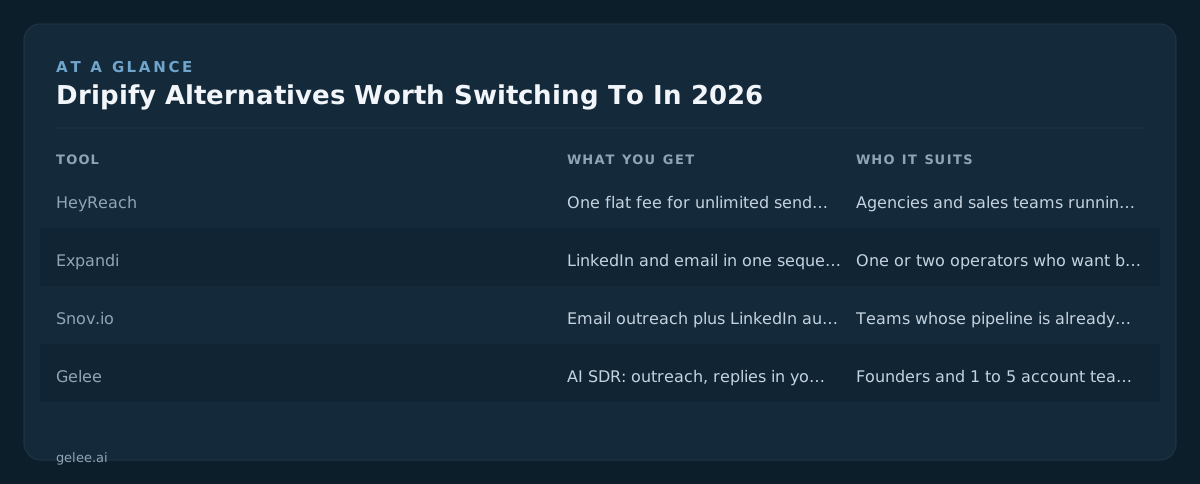
It depends on which of those four problems you have. For many sender accounts, HeyReach. For LinkedIn and email in one sequence, Expandi at around $99 per account per month. For email-first teams who want LinkedIn attached, Snov.io. For a founder who wants the replies handled and the meeting booked, an AI SDR rather than a sender.
| Tool | What you get | Who it suits |
|---|---|---|
| HeyReach | One flat fee for unlimited sender accounts, per their own comparison, plus a unified inbox | Agencies and sales teams running 10 to 50 accounts with people to work them |
| Expandi | LinkedIn and email in one sequence, around $99 per account per month | One or two operators who want both channels and will write the copy |
| Snov.io | Email outreach plus LinkedIn automation in one platform, 4.5 on G2 | Teams whose pipeline is already mostly email |
| Gelee | AI SDR: outreach, replies in your voice, objection handling, meeting booking, content. Custom pricing, shared on a demo call | Founders and 1 to 5 account teams with nobody to answer replies |
The Expandi row is the one people misread. Around $99 per account per month is $1,188 a year for one operator, and $2,376 once you add a second sender. That buys the sending across both channels. Writing two sequence variants a month and answering 30 replies is still yours, and that is the part that lands at 9pm.
What is the cheapest Dripify alternative?
The cheapest invoice is a single-seat Chrome extension, and there are plenty under $60 a month. Whether that is actually the cheapest depends on one number: how many hours a month you spend running it. At 20 hours and $50 an hour, you are adding $1,000 of your own time to a $59 bill.
Work it through at your own rate. Twenty hours is about 25 invites a day, writing two or three sequence variants a month, and answering 30-odd replies. At $100 an hour that is $2,000 on top of the tool. A contractor doing the same thing at $30 an hour costs $600.
So the cheap tool wins outright when you are sending 100 to 200 invites a month and replies arrive twice a week. It stops winning around 500 invites, where reply handling becomes a daily job.
Which alternative handles 20 or more sender accounts?
HeyReach, and it is the clear answer for that buyer. One flat fee covers unlimited sender accounts and every reply lands in one inbox, so the per-account cost falls the more accounts you add. If you run an agency with 30 client accounts, nothing on this page beats that arithmetic.
Run the volume before you budget, though. Thirty accounts at 20 invites a day across 22 working days is 13,200 invites a month. At a 20 to 30% accept rate that is 2,640 to 3,960 new connections, and 12 to 18% of those reply, so 300 to 700 conversations land in that unified inbox every month. That is two or three people answering messages full time, and the subscription is the smaller half of the budget.
Gelee is the wrong purchase for that agency. It is built around a small number of accounts, with the AI trained on one voice and one objection playbook, which is the opposite of what a 30-account operation needs. Buy the multi-account tool and staff it.
Do you need LinkedIn and email in one sequence?
Only if you have verified email addresses for most of the list. Expandi runs both in one sequence at around $99 per account per month, and Snov.io comes at it from the email side. If your enrichment hit rate is under 50%, you are paying for a second channel that fires for half your prospects.
A quick check before you buy: pull 100 prospects from your last campaign and count how many have a work email you would actually send to. If it is 30, LinkedIn-only is fine and you should spend the difference on better targeting. If it is 80, the dual-channel tools earn their price.

What numbers should a replacement actually produce?
Ours, published so you can hold a vendor to them: 20 to 30% connection accept, 12 to 18% reply to the first message, 5 to 8% on follow-ups, and 3 to 5% of invites ending as a booked meeting. At 500 invites a month that is 15 to 25 meetings. Safe volume is 20 to 25 invites a day on a warm account.
If a shortlisted tool will not tell you its accept rate, assume it is below 20%. And when your accept rate sits at 11%, the sequence is rarely the problem. People open your profile before they accept, so the headline and the first two lines of your About section are doing the deciding. The LinkedIn headline rewriter rewrites both in a couple of minutes, for free, before you pay anyone a subscription.
Where does the LinkedIn session run, and why does it matter?
Two architectures exist. A Chrome extension drives LinkedIn from your own browser, so it only sends while your laptop is awake and you are logged in. A hosted tool runs the session on a server with a dedicated IP and sends whether you are there or not. Ask which one you are buying before you pay.
Founders on Reddit compare Dripify alternatives by where the session actually runs, and the difference shows up on the days you travel. An extension sends nothing while the laptop is shut, so a 25-a-day plan quietly becomes 18 a day across a month with two conference trips in it.
LinkedIn does not publish a daily limit. It moves with account age, how many people accept you, and how many report you. On a brand new account, 5 to 10 invites a day for the first two weeks is the sane ramp, whichever architecture you pick.
When is an AI SDR the right replacement for Dripify?
When the bottleneck moved from sending to replying. If you already get 20 to 30 replies a month and answer them three days late, a faster sender makes the backlog worse. Gelee writes the outreach in your voice, answers the replies, handles objections from your playbook, and books the meeting on your calendar.
It also covers the part most automation tools ignore, which is that outbound works better when your feed is active. LinkedIn reach fell hard in 2026 and cold invites from a dormant profile accept worse than invites from someone whose posts the prospect has seen. The Post Commenters preset DMs everyone who comments on a watched post, then replies publicly once the DM is confirmed sent, which is the same job people try to do with ManyChat-style comment automations.
Who should not switch, and which one should you buy?
Do not switch if you have an SDR who knows your current tool, hits 20 invites a day, and answers replies the same afternoon. Swapping tools costs two weeks of reduced sending during the ramp, and you get nothing back for it. Fix targeting instead.
Switch to HeyReach if you run 10 or more sender accounts and have people to work them. Switch to Expandi at around $99 per account if you have email addresses for most of your list and one operator who enjoys writing copy. Switch to Gelee if you are a founder with one to three accounts, 30 unanswered replies, and no intention of hiring an SDR this quarter. There is no self-serve signup, setup takes 15 minutes on a call, and pricing is covered there.